
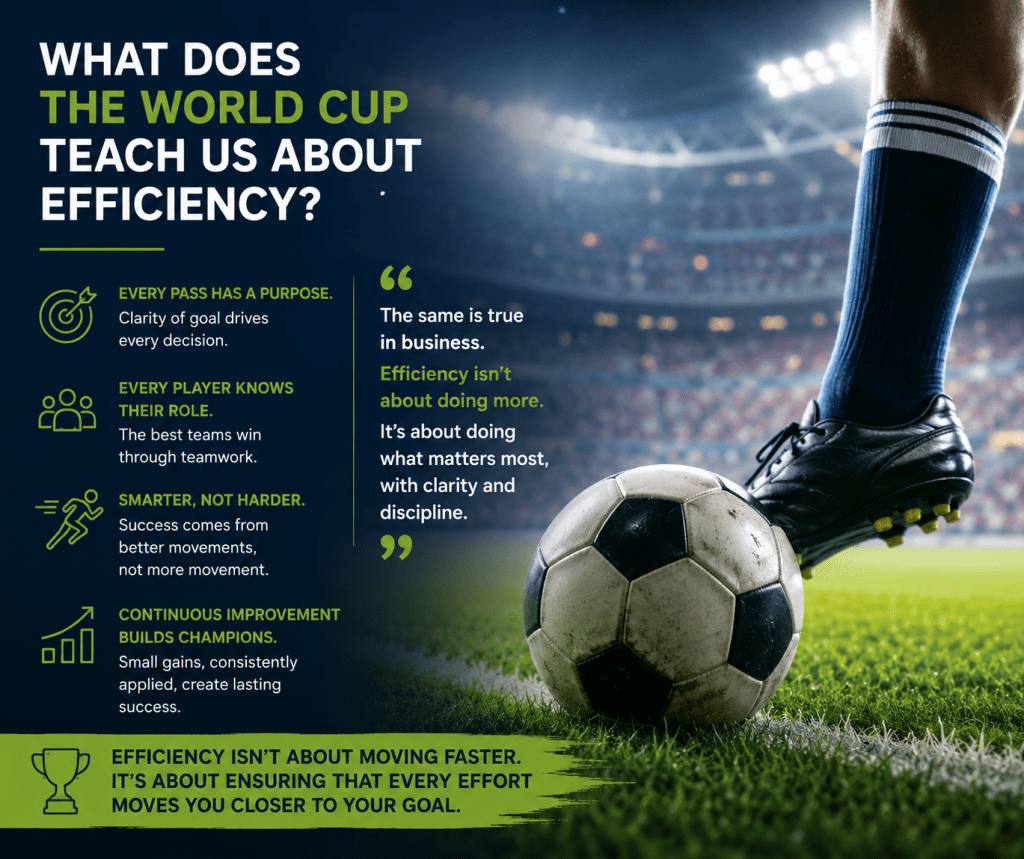
Every four years, the World Cup captures the attention of millions. We marvel at moments of brilliance, stunning goals and world-class talent. But behind every successful team lies something far less glamorous—and far more important.
Efficiency.
The teams that go the furthest are rarely those with the biggest names alone. They’re the teams that work together seamlessly, make smart decisions under pressure and use every opportunity to their advantage.
There’s an important lesson here for businesses, organisations and individuals.
Being Busy Isn’t the Same as Being Productive
Many organisations pride themselves on being busy. Calendars are full, inboxes are overflowing and meetings fill the day.
But activity doesn’t always equal progress.
Just as elite football teams don’t run aimlessly around the pitch, successful organisations don’t waste time, money or effort on activities that don’t add value.
Efficiency is about ensuring that every action has a purpose.
Every Pass Has a Purpose
Watch any top international team and you’ll notice something.
The best players don’t keep the ball longer than necessary. They move it quickly, communicate constantly and trust their teammates.
Business should be no different.
Every process should have a clear purpose.
Every meeting should result in a decision.
Every investment should create value.
When unnecessary complexity is removed, organisations become faster, more agile and better equipped to respond to change.
Great Teams Eliminate Waste
Football managers constantly analyse performance to identify small improvements.
They look at positioning, movement, decision-making and teamwork.
Businesses should do exactly the same.
Waste isn’t just about excess materials or rising energy bills.
It includes duplicated work, unnecessary approvals, outdated systems, poor communication and time spent on low-value activities.
Small inefficiencies may seem insignificant on their own, but together they can significantly reduce productivity and profitability.
Preparation Wins Championships
World Cup success isn’t built during the tournament.
It is built over months and years of planning, coaching and continuous improvement.
The same principle applies in business.
The organisations that consistently outperform their competitors are those that regularly review their operations, embrace innovation and challenge themselves to improve.
They don’t wait for problems to arise before taking action.
They prepare.
Leadership Sets the Standard
Every successful team has leaders who inspire confidence, communicate clearly and keep everyone focused on the shared objective.
The same is true in every successful organisation.
Leaders create a culture where people understand their roles, take ownership of outcomes and continually look for better ways of working.
Efficiency isn’t simply an operational issue.
It starts with leadership.
The Competitive Advantage
In today’s world, organisations face rising costs, increasing customer expectations and greater competition than ever before.
Those that continue doing things the way they’ve always been done risk falling behind.
Those that embrace efficiency gain a significant competitive advantage.
They reduce costs.
Improve productivity.
Make faster decisions.
Deliver better customer experiences.
And create more time to focus on innovation and growth.
Final Whistle
The World Cup reminds us that success isn’t about doing more.
It’s about doing the right things exceptionally well.
Whether you’re leading a business, managing a team or looking to improve your own productivity, the principles remain the same:
- Have a clear strategy.
- Work together.
- Remove unnecessary complexity.
- Continuously improve.
- Focus on what creates value.
Because in football—and in business—the winners are rarely the busiest.
They’re the most efficient.
At EfficiencyDoctors.ie, we help organisations identify waste, simplify processes and improve performance. Because lasting success doesn’t come from working harder—it comes from working smarter.


Leave a Reply